From Hesitation to Habit: Public Transport with a Mobility Aid in Bath
The first journey after a change in mobility is often the hardest. The front door can begin to feel like a boundary rather than a starting point. Yet everyday independence rarely returns in one dramatic leap. It is rebuilt through short, repeatable trips: the bus into town, the train to a familiar destination, the taxi home after an appointment.
Bath presents particular challenges. The city centre is compact but hilly, pavements can be narrow, and buses fill quickly at peak times. None of this makes public transport impossible. It does mean that planning, practice and a realistic pace matter.
Start with One Familiar Route
Choose a journey you already know well and that matters to you: a local shop, a GP surgery, a friend's house or a regular appointment. Travel it first with a companion at a quiet time of day. Then repeat it. Familiarity reduces the mental load of checking timetables, finding the stop and managing equipment while others are waiting.
The aim is not to become an expert immediately. It is to prove to yourself that the route works. Once one journey feels ordinary, the next one usually feels easier.
Know What Help You Are Entitled To
Assistance is not a favour; it is part of the service. Knowing what to ask for makes it easier to request.
Bus travel and the concessionary pass
In England, the English National Concessionary Travel Scheme provides free off-peak bus travel for eligible older and disabled people. In Bath and North East Somerset, applications are handled through the council. An older person's pass and a disabled person's pass have different eligibility rules, and a disabled person's pass may allow a companion to travel free in certain circumstances. Check the current terms before relying on them.
Most local buses are low-floor vehicles with a ramp that the driver can deploy. There is usually a designated wheelchair or buggy space. Drivers can assist with the ramp, but they are not expected to lift passengers or heavy equipment. Foldable walkers and rollators can often be carried, provided they do not obstruct the aisle. Rules for scooters vary by operator, so confirm before travelling.
Rail and Passenger Assistance
National Rail's Passenger Assistance service allows you to book help at stations and on trains. It is free and can cover ramps, assistance to your seat, luggage help and connections. Booking ahead is strongly advised, ideally at least a day before travel and no later than the operator's stated deadline. Turn-up-and-go help is not guaranteed at every station.
Bath Spa station has lifts to its platforms, but it is worth checking the accessibility of both your departure and arrival stations. Great Western Railway and other operators publish detailed station information. If you use a wheelchair, confirm the space and the boarding arrangements when booking.
Taxis and private hire
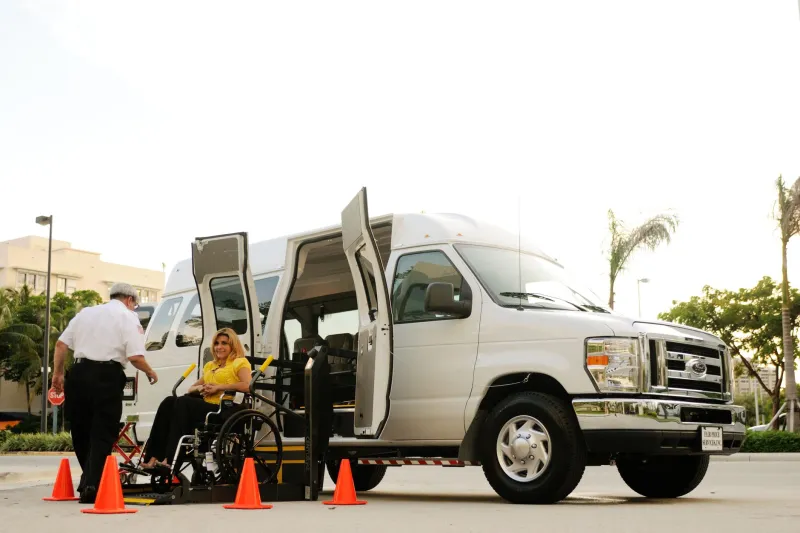
Bath and North East Somerset Council licenses taxis and private hire vehicles. Some vehicles are wheelchair accessible, and drivers have legal duties under equality legislation to assist passengers and carry assistance dogs without extra charge. Accessibility is not universal, so pre-book where possible, state clearly that you use a wheelchair or mobility aid, and ask for a vehicle with a ramp or step-free access.
Taxi ranks at Bath Spa station and in the city centre are useful, but they can be busy at peak times. A pre-booked private hire vehicle may be calmer, though it is wise to confirm the fare estimate and the vehicle type in advance.
Choose Quieter Times and Build a Backup Plan
Mid-morning and early afternoon are often calmer than the school run or the evening commute. Avoid Bath Christmas Market days, major match days and heavy rain if these make boarding harder. Carry a charged phone, a small emergency contact card and enough time to wait for the next service if the first one is full.
It also helps to have a fallback. That might be a taxi number saved in your phone, a friend who can collect you, or simply the knowledge that you can return home and try again another day. A backup plan is not a sign of failure; it is part of travelling confidently.
Seven Gentle Steps from Doorstep to Destination
- Check the route before you leave. Use operator apps or printed timetables, and note the stop names in both directions.
- Arrange assistance in advance. Book Passenger Assistance for rail, and ask the bus operator about ramps or scooter rules if you are unsure.
- Prepare your aid. Charge powered equipment, check brakes and ferrules, and fold or secure bags so your hands are free.
- Leave a buffer. Arrive at the stop or station early enough to board without rushing.
- Speak to staff or the driver. A brief, clear request, such as "Please could you deploy the ramp?", is usually enough.
- Board slowly and deliberately. Use handrails, take the designated space and secure brakes before the vehicle moves.
- Review the journey afterwards. Note what worked and what you would change. Then plan the next short trip.
If Something Goes Wrong
A missed bus, a broken lift or an unhelpful driver can shake confidence. Record what happened, including the time, route and vehicle number where possible. Report the issue to the operator. For taxi concerns, contact the council's licensing team. For rail assistance problems, raise it with the train operator or Passenger Assistance.
One difficult journey does not mean public transport is closed to you. It may mean that a different time, route or assistance arrangement is needed.
Local Support and Everyday Independence
Bath and North East Somerset Council, local community transport schemes and disability advice services can help with passes, accessible travel information and sometimes door-to-door transport. Mobility retailers can also advise on equipment that is practical for buses and trains.
Confidence is not the absence of difficulty. It is the settled knowledge that you can manage the difficulties that arise. Start small, ask for the help that exists, and let each completed journey become evidence that the front door is still a beginning.