When a Mobility Aid Changes Hands: Questions Worth Asking Before You Accept
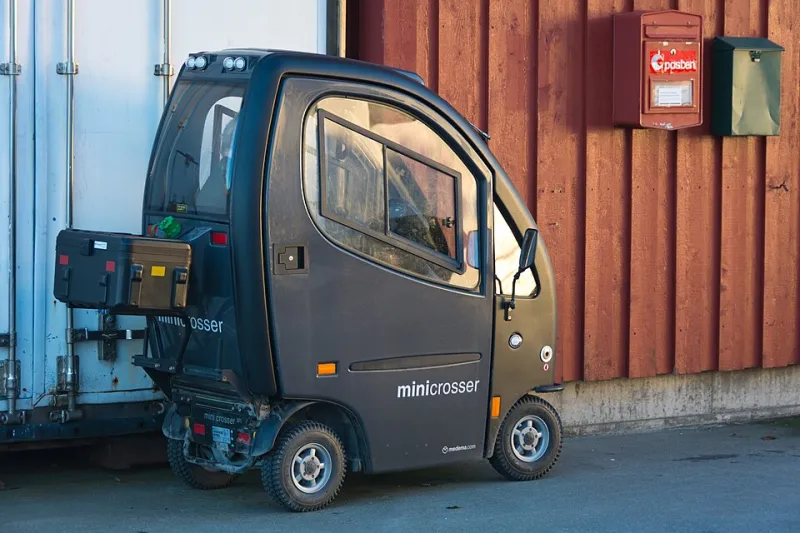
Photo: Gordon Leggett, CC BY 4.0, via Wikimedia Commons
An offer of a used mobility aid is rarely just a transaction. It is a favour, often from someone who cares and who may have spent a great deal of money on the equipment. The giver does not want to seem pushy; the receiver does not want to seem ungrateful. Yet a scooter, rollator or wheelchair is safety-critical equipment, and the wrong one can be unsafe, unsuitable or unexpectedly expensive. The aim is not to interrogate the giver but to have a handover conversation that protects both of you.
Start with gratitude, then name the purpose
A simple framing helps. Try: ‘Thank you, that is very generous. Before I say yes, may I ask a few practical questions so I can use it safely?’ This makes clear that the questions are about responsibility, not suspicion. It also gives the giver permission to be honest about faults, because you have already shown that you are taking the equipment seriously.
Battery age and condition
Battery condition is the single most important question for a used scooter or powered wheelchair. Ask: ‘Do you know when the battery was last replaced? Is there a date code on it?’ A lead-acid battery that is several years old may still start the scooter in the hallway but fail on a slope. Lithium batteries age differently, but they also have a finite life and should be checked for swelling, damage or a charger that becomes unusually hot.
If possible, test the aid under load rather than only on the flat. Check the tyre pressures first if they are pneumatic, then try a gentle slope. Ask how far the aid was routinely used and whether it was stored charged or left flat for long periods. A replacement battery can cost a significant proportion of the value of a second-hand machine, so this is not a minor detail.
Paperwork, model and serial number
Ask for the manual, the charger, any receipt, warranty information and service records. The serial number matters because it identifies the model and can help a technician order the right parts. A missing charger is not a small omission: replacement chargers can be expensive and model-specific, and using the wrong charger is a fire risk.
It is also reasonable to ask whether the model has been subject to a safety notice or recall. You can check with the manufacturer or a reputable mobility dealer. If the giver cannot find the paperwork, make a note of the model and serial number yourself before accepting.
Servicing history and safety checks
Ask: ‘Has it been serviced, and do you have a record of what was done?’ If there is no history, budget for a professional inspection before first use. The checks should include brakes, tyres, tiller or joystick operation, seat and armrest fixings, the freewheel lever, lights, horn and anti-tip wheels. Look for rust at joints, cracked plastic panels, frayed cables and non-standard repairs.
A free aid with bald tyres and soft brakes is not free. It is a project. That may still be worthwhile, but it should be a deliberate choice rather than a surprise.
Spare parts and discontinued models
Older scooters can become orphans. Ask: ‘Is this model still supported? Can tyres, batteries and controllers still be ordered?’ A local mobility technician may be able to help, but some discontinued models require parts that are difficult or impossible to source. Before accepting, make a short list of the consumable parts you are likely to need and check whether they are available.
Insurance, storage and charging
Tell your home insurer before you accept the aid. Household policies vary: some cover mobility equipment in the home but not away from it, and some exclude powered vehicles altogether. Specialist mobility insurance may be needed, especially for class 3 scooters used on the road. Ask whether the giver’s insurance ends on transfer and whether any registration or documentation needs to change.
Storage and charging also deserve a conversation. Follow the manufacturer’s instructions for charging, and do not charge a battery in a hallway or escape route if that can be avoided. If the aid is to live in a shed or garage, consider whether damp and cold will affect the battery and electronics.
The honest signs that a free aid may cost more than it saves
Be cautious if any of the following apply:
- There is no charger, no manual and no serial number.
- The battery does not hold charge or the charger becomes very hot.
- The frame is cracked, badly rusted or has been welded.
- Anti-tip wheels or other safety fittings are missing.
- Tyres are perished, bald or unevenly worn.
- Brakes are weak or the aid creeps on a slope.
- The model is discontinued and spare parts are unavailable.
- The repairs look non-standard or improvised.
Add up the likely costs of a battery, charger, tyres, service, insurance, transport and storage. Compare that total with a second-hand aid that has a clear history, or with a new entry-level model. Sometimes the generous offer is still the right one; sometimes it is kinder to both parties to decline.
How to say no without damage
If the aid is not right, avoid saying that it is rubbish. Try: ‘I am very grateful, but this one is not right for my needs. It would be safer for me to keep looking.’ You can also invite the giver to help in another way: ‘Perhaps you could come with me to look at options?’ That keeps the generosity intact while protecting your safety.
If you accept
Put the handover in writing. Note the date, model, serial number, known faults and battery age. A simple signed note is not an act of distrust; it prevents confusion later. Book a check by a mobility technician before you rely on the aid, keep the manual with the equipment, and register the product with the manufacturer if that is possible. A respectful conversation at the start is far easier than an awkward one after a fault.